

Industry Trends
Global Comparison of Quantum Enterprises: The United States is significantly ahead, while China is in the top tier
Date:2025-12-15 Views:14
C114 News, December 15th (Yunqing) At the "2026 China Academy of Information and Communications Technology Deep Observation Report" held recently, the "Research Report on the Development and Application of Quantum Information Technology (2025)" was officially released.
The report shows that the number of global quantum information related enterprises has exceeded 800, with the quantum computing field dominating, accounting for about 50%. The PQC field is developing rapidly, with over 100 related enterprises. The number of quantum information companies has been steadily increasing year by year, entering a period of rapid growth for startups since 2017. It has declined slightly in 2022, but has maintained an average growth rate of about 60 companies per year in the past five years, reflecting that quantum information has become an important direction for countries around the world to develop emerging technologies and cultivate future industries.
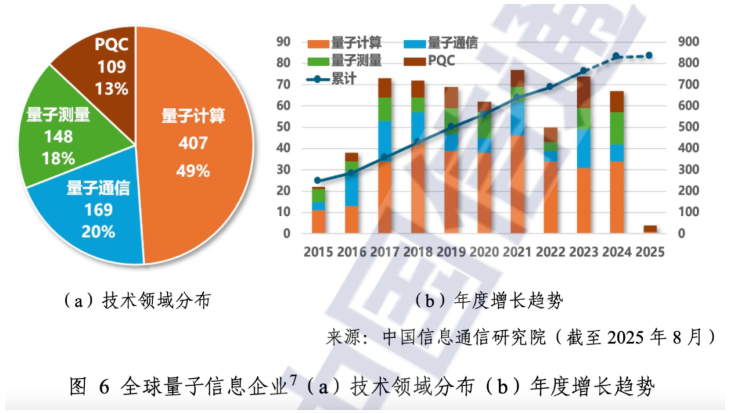
From the distribution of enterprise countries, there are over 230 quantum enterprises in the European Union, accounting for 29%, of which over 70 are in Germany. There are over 210 quantum companies in the United States, accounting for 26%. There are over 140 quantum enterprises in China, accounting for 17%. In addition, there are also many quantum companies in the UK, Canada, Japan, South Korea, and India. From the perspective of technology distribution, the quantum computing industry in Europe and America has a high degree of ecological clustering, with nearly six times the number of related enterprises in China. In the field of quantum communication, China leads in the number of enterprises, while the United States leads in the field of quantum measurement. PQC is mostly newly established by start-ups and information security companies, and there is still a certain gap in the number of Chinese enterprises compared to Europe and America.
当前,全球已有11家量子企业登陆资本市场,其中加拿大4家、中美各有3家。量子上市企业平均市值达到29亿美元,较去年有大幅提升,显示资本市场认可度。美国量子上市企业平均市值达到67亿美元,远高于其他国家和地区。截至2025年8月,美国IonQ以133亿美元市值,成为全球首家市值超百亿美元的量子企业。2025年上半年IonO密集开展资本市场运作,收购了OxfordIonics、IDQ等5家量子领域知名企业,进一步扩展多领域业务能力。
There are 12 quantum unicorn companies that have not yet entered the capital market. Including 10 quantum computing companies, as well as 1 quantum communication company and 1 quantum measurement company. From a regional perspective, the United States has 5, China has 4, and Canada, Finland, and France each have 1. From the perspective of corporate valuation, the average valuation of American quantum unicorns is $4.1 billion, far exceeding the global average, with PsiQuantum ranking first with a valuation of $6.75 billion. The average valuation of quantum unicorns in China is 1.4 billion US dollars, with a significant gap. In addition, there are 10 quantum quasi unicorn companies worldwide (valued at over $100 million) all concentrated in the field of quantum computing, with the United States occupying 4 seats and China having 2. French quantum computing startup Alice&Bob ranks first with a valuation of $400 million.
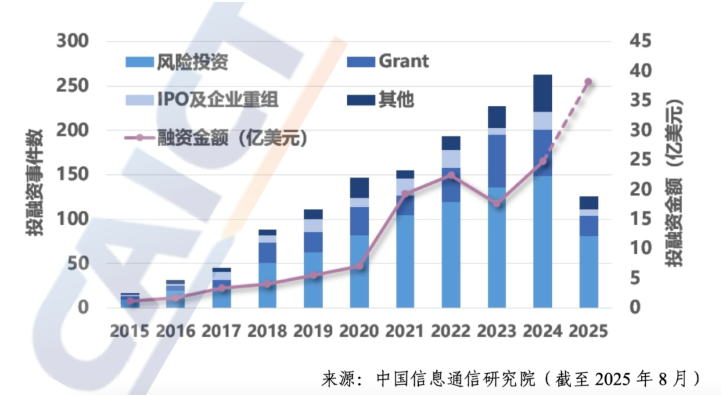
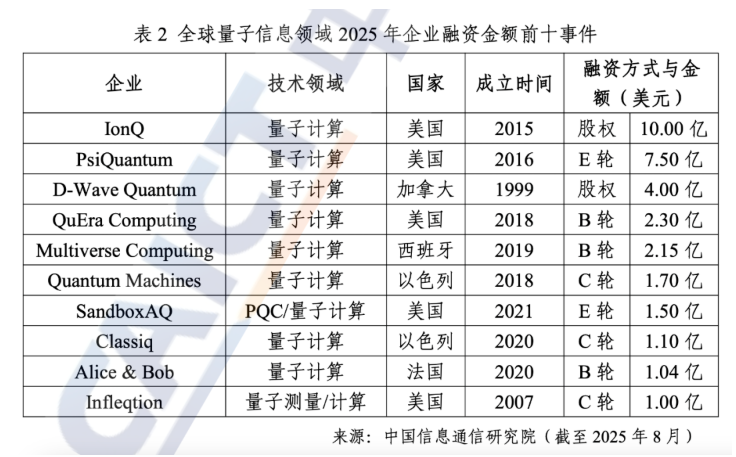
From the perspective of investment and financing, the leading position of the United States is still significant. Quantum computing star companies have become a hot topic in the capital market. In March, PsiQuantum in the United States completed a $750 million Series E financing, and in July, IonO completed a $1 billion equity financing, becoming the highest record for a single financing scale for a quantum enterprise. European and American quantum companies occupy 8 seats in the top ten financing events, while the other 2 Israeli quantum computing companies have close ties to the European and American ecosystems. Leading companies such as PsiQuantum and SandboxAQ have gradually entered the later stages of venture capital, reflecting the market's high recognition of their future development prospects.
The report concludes that China's quantum information technology and industrial development level are overall among the top in the world, with a solid foundation for building future industrial competitiveness. In terms of planning and layout, since the 14th Five Year Plan, the development plans, overall plans, industrial actions, development opinions and other policy layouts in the field of quantum technology and industry have been continuously improved, and major scientific and technological projects and large scientific facility platforms have been steadily promoted. In terms of technological strength, Hefei National Laboratory, Greater Bay Area Quantum Science Center, Beijing Institute of Quantum Technology, etc. have become important sources of quantum technology innovation, and China Telecom, China Electronics Technology Group, etc. have driven the construction of the domestic industrial system. In terms of innovative achievements, important achievements such as the "Zuchong" superconducting quantum computing prototype, the "Jiuzhang" optical quantum computing prototype, the "Tianyuan" quantum simulator, and the "Mozi" quantum science satellite are at the international leading level. In terms of supply chain guarantee, important equipment such as high-end lasers, high-performance single photon detectors, dilution refrigerators, electron beam exposure machines, and high-performance time analyzers have achieved breakthroughs in localization. In terms of technology industry clusters, Anhui, Beijing, Shanghai, Guangdong Hong Kong Macao Greater Bay Area and other places have taken the lead in promoting the development of quantum technology and future industrial layout, creating quantum technology centers and industrial clusters. In terms of talent support foundation, 17 universities across the country have opened undergraduate majors in quantum information science. Tsinghua University, Peking University, University of Science and Technology of China, Beihang University and other universities have explored models such as quantum technology colleges, quantum information classes, and integrated undergraduate, graduate and doctoral training, providing strong support for future industrial development.